Product Types and Attributes
Product Experience Manager allows for a range of product types to accommodate various business needs. Understanding the distinctions between these types is critical for organizing your catalogs and ensuring smooth operations across your stores.
Products can be standalone items or part of a bundle. Product bundles may be fixed, or dynamic, where the shopper can select a product from any number of options. Products may also be part of a product variation, where a parent product defines certain product criteria and child products are defined by each unique variation combination. Both regular and bundled products can have product variations. Products and bundles can be setup as repeat products, or subscription products, where they are included as part of a subscription offering.
All of these can be a physical goods, digital goods or a services.
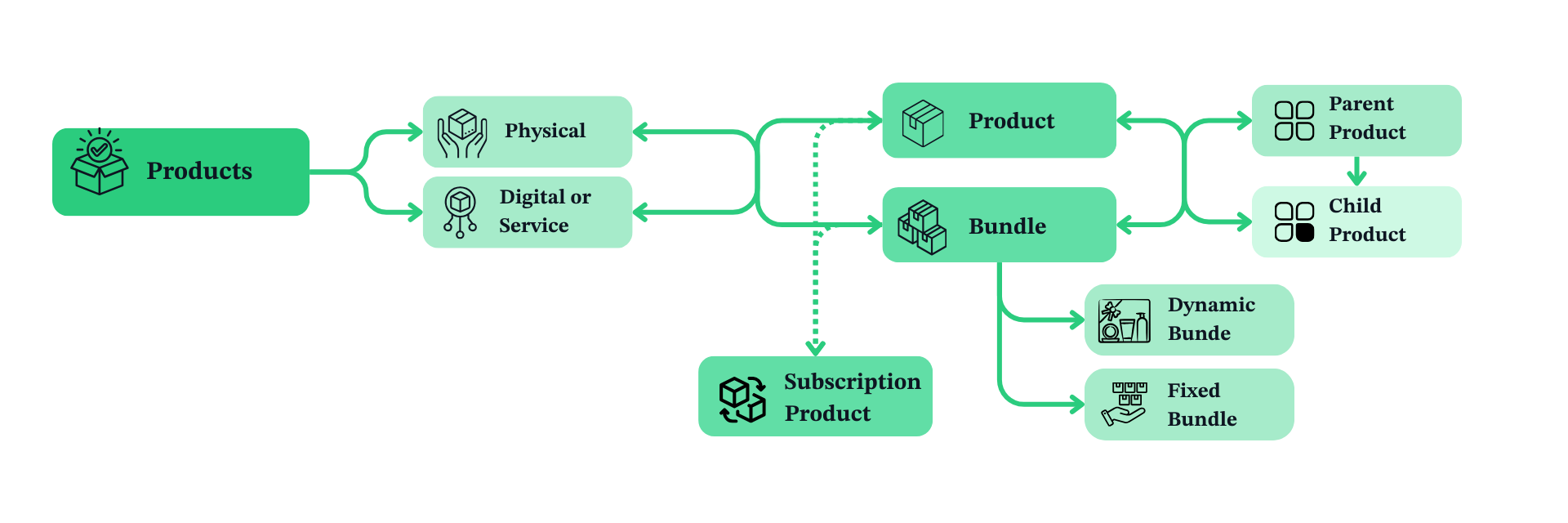
- Standard Products
- Parent Products
- Child Products
- Bundled Products
- Repeat Products
Standard Products are standalone products, like a single hat or a book, without any variations or components.
Parent Products serve as the base for building child products. Parent products contain shared attributes and variations such as size or color.
Child Products are derived from parent products, each child product reflects a unique combination of variations (e.g., a size large, red T-shirt).
Bundled products are comprised multiple products that can be sold together as a single unit, and can be fixed or dynamic. Bundles can also be used as a product configurator for custom products, or to create product assemblies.
Repeat Products are products tied to subscriptions, and available to be sold as part of a subscription offering or reoccurring order.
Defining Product Attributes
Each product also has a set of standard attributes including name, description, SKU, and slug (ID). You may also extend products with custom attributes to define unique characteristics for the products in your store. These custom attributes are created and associated to your products as part of a template. For example, a furniture retailer may include attributes for product dimensions or place of origin.
Attributes can also be used for personalization, for example, by allowing customers to add personalized text to a greeting card. You can also have localized attributes for multilingual stores, where you can provide different names and descriptions based on the selected language.